Decision Aids for Switching Medications: Understand the Risks and Benefits
Medication Switch Decision Aid Calculator
Understand Your Medication Choices
This tool helps you compare medication options by showing the real risks and benefits. See how different choices affect your health outcomes and understand what matters most to you.
What condition are you considering switching for?
Why switching medications isn’t just a doctor’s call
Changing your medication isn’t like switching phone plans. You can’t just pick the one with the cheapest monthly fee or the fanciest features. Every drug comes with trade-offs-some reduce your risk of a heart attack, but might cause weight gain. Others help with depression but could make you feel dizzy all day. And if you don’t truly understand those trade-offs, you’re more likely to stop taking it altogether. Studies show that between 25% and 50% of patients quit their meds within the first year, not because they’re not working, but because they didn’t feel heard or informed.
This is where decision aids come in. These aren’t fancy apps or flashy brochures. They’re structured tools designed to help you and your doctor make a real, shared choice about your treatment. They lay out the facts: what’s likely to happen if you stay on your current drug versus switching. They show you the numbers-not vague promises, but clear probabilities. And they ask you what matters most to you: cost? Dosing frequency? Fear of a specific side effect?
What’s actually in a medication decision aid?
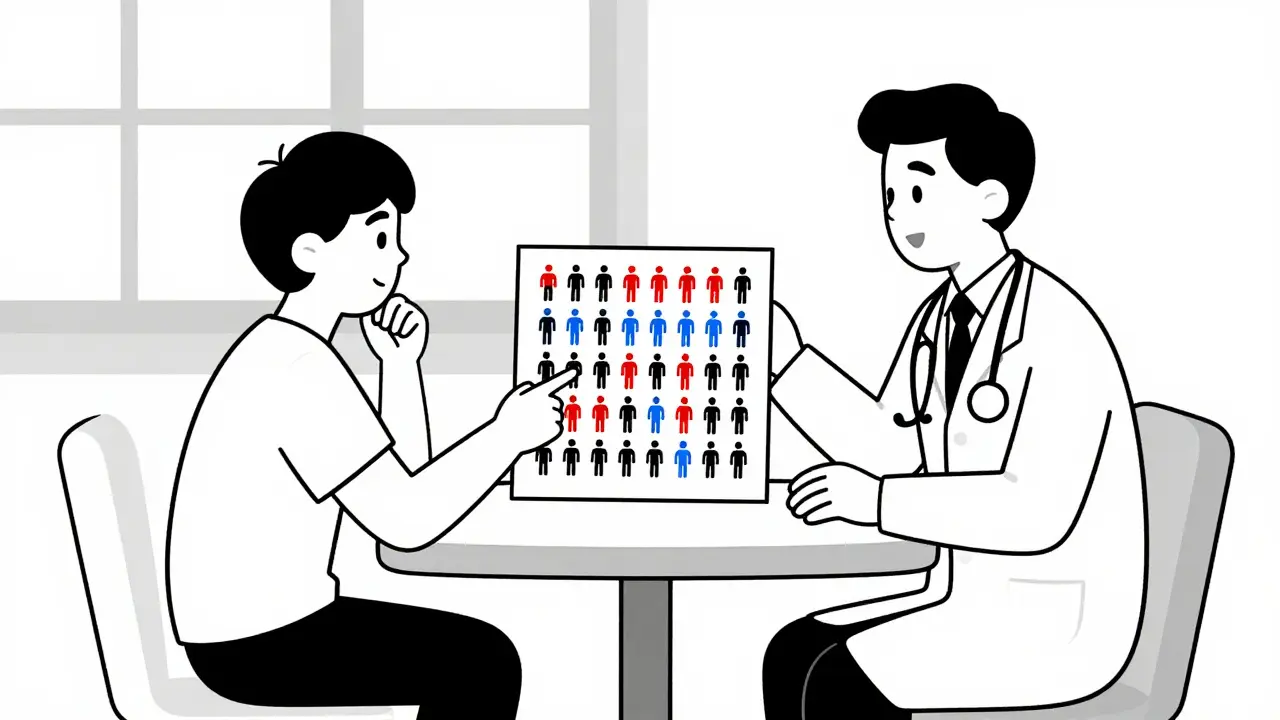
Good decision aids don’t just list pros and cons. They give you the real math behind the risks. For example, instead of saying, “This drug lowers your chance of stroke,” it says: “Out of 100 people like you, 10 will have a stroke in five years without this drug. With it, that number drops to 8. So, 2 people out of 100 will avoid a stroke.” That’s called an absolute risk reduction. It’s much clearer than saying “reduces risk by 20%,” which sounds bigger than it is.
Many tools use icon arrays-tiny pictures of 100 people, with some colored in to show who might experience a side effect. If 30 out of 100 people gain weight on a certain drug, you’ll see 30 colored icons. No jargon. No spin. Just visuals that make the numbers stick.
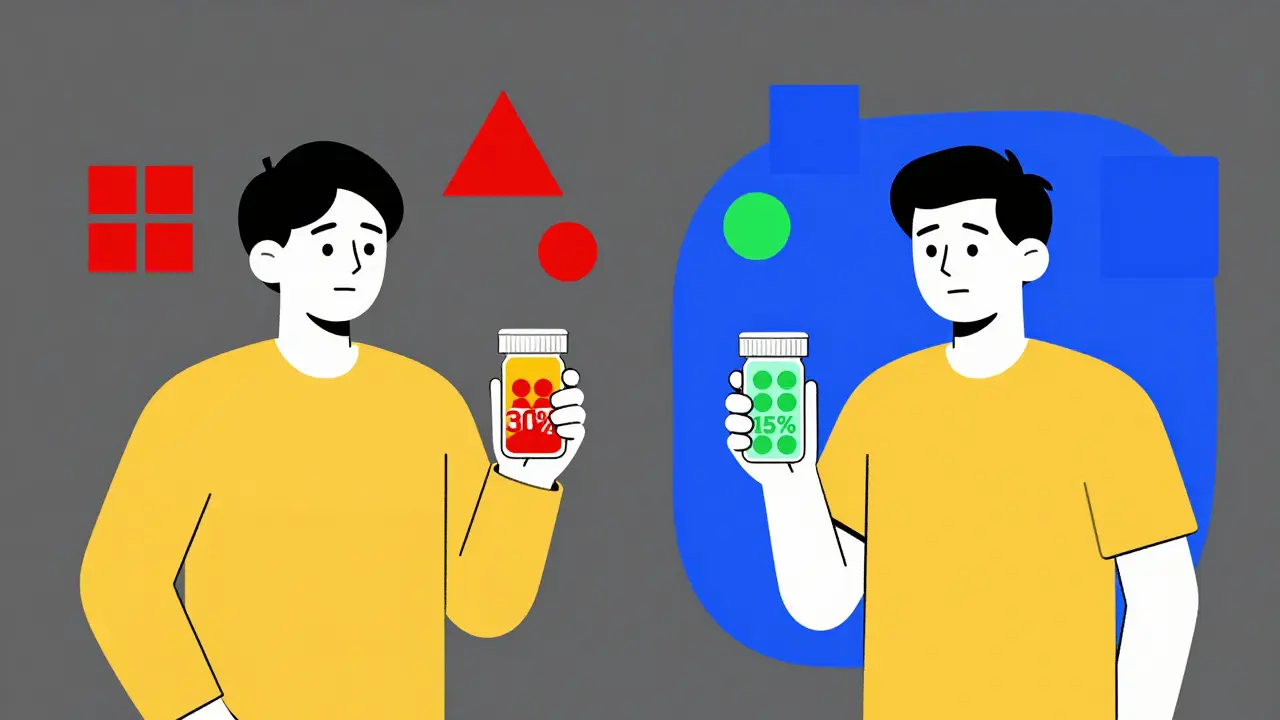
They also compare options side by side. Let’s say you’re thinking about switching from one diabetes pill to another. One might cause more nausea. The other might raise your risk of urinary tract infections. A decision aid puts both side effects on the same table with actual percentages: “Medication A: 30% chance of nausea. Medication B: 15% chance of UTI.” You can see the difference at a glance.
And then comes the part most doctors don’t have time for: value clarification. You’re asked to rank what matters most. Is avoiding weight gain more important than cutting your stroke risk? Do you care more about taking one pill a day versus two? These tools force you to think about your own life-not just the medical data.
How do they compare to regular doctor advice?
Traditional counseling often sounds like this: “This new drug works better. Let’s switch.” No numbers. No options. No real discussion. Decision aids change that. A 2022 review found patients who used decision aids remembered 32% more about their treatment options six months later than those who just got a pamphlet. They also felt less conflicted-28% less decisional stress.
They’re especially powerful when there’s no single “best” option. For example, when choosing between different antidepressants or blood thinners, multiple drugs are equally effective. That’s when your personal preferences become the deciding factor. One study showed that when decision aids were used, 41% more patients ended up on a medication that matched their values.
But they’re not magic. If you’re in a hurry-like during an emergency room visit-or if you have trouble processing numbers or complex info (like with advanced dementia), these tools won’t help. And if your doctor doesn’t use them properly, they can backfire. Some patients told researchers they felt overwhelmed, like they were being asked to be a doctor themselves.
Real stories: What patients actually say
On Reddit, a veteran named u/VetMedSurvivor shared how a VA decision aid helped him switch from warfarin to a newer blood thinner. “The icon array showed 100 people with 8 bleeding events on warfarin and only 3 on the new one,” he wrote. “That made it real. I didn’t just hear ‘lower risk.’ I saw it.” He’s been on the new drug for two years with no issues.
Another patient, after using a decision aid for antidepressants, decided to stay on her old medication. The new one had a 25% chance of causing sexual side effects. “I knew it might work better for my mood,” she said, “but I couldn’t live with that. The tool gave me permission to say no.”
Not everyone has a good experience. Some people struggle with the tech. Others say the tools made everything feel too equal-like all options were equally good, even when one had much stronger evidence. One case report described a patient who switched to a drug with weaker proof of benefit just because the decision aid presented it as “just as good.” That’s a red flag. Good decision aids don’t hide the strength of evidence-they highlight it.
Who’s using these tools-and who isn’t?
They’re most common in the VA system, where 68% of mental health clinics use them regularly. That’s because the VA has invested in training and integration. In regular primary care? Only 29% do. Why? Time. A 2023 study found that using a decision aid adds 7 to 12 minutes to a doctor’s visit. In a system where appointments are 10 minutes long, that’s hard to swallow.
Doctors also worry about overwhelming patients. One survey found 68% of primary care providers say decision aids disrupt their workflow. But those who stuck with them say it gets easier. After five uses, the extra time dropped from 12.7 minutes to just under 5 minutes. The learning curve is real-but it flattens out.
There’s also a cost issue. While many tools are free (from universities like Ottawa or the VA), commercial platforms charge health plans. And updating them is expensive. Drug labels change. New studies come out. A decision aid needs to be refreshed every 18 to 24 months-or it becomes outdated. Only 38% of hospitals have dedicated money to keep them current.

What’s next for decision aids?
The future is personalization. Intermountain Healthcare launched an AI tool in early 2024 that adapts the way risks are shown based on how you learn. If you respond better to pictures, it shows more icons. If you like numbers, it highlights percentages. It even adjusts tone-if you’re anxious, it softens the language.
The FDA is stepping in too. In 2024, they proposed new rules requiring decision aids to be tested on real patients with different backgrounds and reading levels. No more assuming everyone understands “relative risk.”
And money is starting to follow. Medicare now rewards health plans that use shared decision-making for expensive drugs. That’s pushing more insurers to adopt these tools. By 2027, experts predict 75% of value-based care settings will use them.
But there’s a warning: if we don’t build systems to keep these tools updated, they’ll become useless. In fast-moving fields like cancer treatment, a decision aid from two years ago might be dangerously out of date.
What you can do today
If you’re thinking about switching meds, don’t just accept the suggestion. Ask: “Is there a decision aid for this?” You can check the Ottawa Hospital’s library or the VA’s collection-both are free and open to the public. Print one out. Bring it to your appointment. Use it to ask better questions.
And if your doctor doesn’t know what you’re talking about, that’s okay. You’re not asking them to use it-you’re asking them to talk with you. Say: “I read about these tools that help people weigh the risks and benefits. Can we go through them together?”
Switching meds isn’t about picking the ‘best’ drug. It’s about picking the right one for you. And decision aids are the only tool designed to make that happen.
Are decision aids only for serious conditions like heart disease or diabetes?
No. Decision aids work for any medication switch where there’s more than one reasonable option. That includes antidepressants, blood pressure pills, cholesterol drugs, and even pain medications. The key is whether the options are equally supported by evidence and the choice depends on your personal priorities. If your doctor says, “We can try this or that,” and both are valid, a decision aid can help.
Can I use a decision aid on my own without talking to my doctor?
You can use one on your own to get clearer about your thoughts, but you shouldn’t make a final decision without your doctor. Decision aids are meant to start a conversation-not replace it. Doctors catch things apps can’t: drug interactions, lab results, signs you might be at higher risk for side effects. The tool helps you speak up. Your doctor helps you stay safe.
Do decision aids cost money?
Most high-quality ones are free. The Ottawa Hospital Research Institute, the VA, and Mayo Clinic offer their tools at no cost. Some commercial platforms charge health plans, but patients usually don’t pay directly. If someone asks you for payment to access a decision aid, double-check the source. Legitimate ones are backed by academic or government health systems.
What if I don’t understand the numbers or percentages?
That’s normal. Decision aids are designed to help with that. Look for tools that use icon arrays-small pictures of people showing how many might experience a side effect. Ask your doctor to explain the numbers out loud. Say: “Can you show me what 15 out of 100 looks like?” You don’t need to be good at math. You just need to understand what matters to you. The goal isn’t to be an expert-it’s to feel confident in your choice.
Can decision aids help me avoid bad side effects?
Yes. That’s one of their biggest strengths. Many patients switch meds and then stop because of a side effect they didn’t expect. Decision aids show you the real chances of each side effect before you start. If you’re terrified of weight gain, and one drug has a 40% chance while another has 10%, you can choose the safer option-even if it’s slightly less effective. Avoiding a side effect you can’t live with is just as important as getting better.
Why aren’t my doctors using these tools more often?
Time and training. Most clinics run on tight schedules, and using a decision aid properly takes extra minutes. Many doctors haven’t been trained to use them effectively. But that’s changing. Medicare now rewards practices that use shared decision-making, and more tools are being built into electronic health records. If you ask for one, you’re helping push the system forward.
Kathy Scaman
January 29, 2026 AT 10:03Mark Alan
January 30, 2026 AT 10:07Timothy Davis
February 1, 2026 AT 04:52Bryan Fracchia
February 2, 2026 AT 13:36Anna Lou Chen
February 4, 2026 AT 09:12fiona vaz
February 5, 2026 AT 18:11Sue Latham
February 6, 2026 AT 22:44Lance Long
February 8, 2026 AT 06:28John Rose
February 9, 2026 AT 10:37Amber Daugs
February 10, 2026 AT 15:46