Narrow Therapeutic Index Drugs: What Patients Need to Know

Some medications are like walking a tightrope. One tiny change in dose - even a little less or a little more - can mean the difference between getting better and ending up in the hospital. These are called narrow therapeutic index drugs, or NTI drugs. They’re not common, but if you’re taking one, you need to know exactly how they work and why even small mistakes matter.
What Makes a Drug Have a Narrow Therapeutic Index?
Every drug has a sweet spot - the amount that helps without hurting. For most medicines, that range is wide. You can miss a dose or take it a little late, and nothing major happens. But with NTI drugs, that sweet spot is razor-thin. The gap between a dose that works and one that’s dangerous is often less than double. That means if your blood level goes up just 10-20%, you could slip into toxicity. Drop it by the same amount, and the drug stops working.
The U.S. Food and Drug Administration (FDA) defines NTI drugs as those where even small changes in blood concentration can cause life-threatening side effects or treatment failure. Think of it like driving a car with no gas gauge. You can’t tell if you’re running low or overfilling - and either way, something bad happens.
Common NTI Drugs You Might Be Taking
You might not realize you’re on an NTI drug. Here are the most common ones:
- Warfarin (Coumadin, Jantoven): Used to prevent blood clots. Too little? You could get a stroke or pulmonary embolism. Too much? You could bleed internally - even from a minor bump.
- Lithium (Lithobid): Used for bipolar disorder. Levels above 1.5 mmol/L can cause tremors, confusion, or seizures. Below 0.6? Your mood may not stabilize.
- Levothyroxine (Synthroid): Replaces thyroid hormone. A small change can make you exhausted, gain weight, or feel anxious - even if you take the same pill every day.
- Digoxin (Lanoxin): For heart failure or irregular heartbeat. Above 2.0 ng/mL? Life-threatening heart rhythms can start.
- Tacrolimus (Prograf): For organ transplant patients. Too low? Your body rejects the new organ. Too high? Your kidneys get damaged.
- Phenytoin (Dilantin) and Carbamazepine (Tegretol): Used for seizures. Small changes can trigger more seizures or cause dizziness, nausea, or even liver damage.
- Methotrexate (Trexall): Used for autoimmune diseases and some cancers. Even small overdoses can cause serious bone marrow suppression.
These aren’t random drugs. They’re all used for conditions where precision saves lives - or ends them.
Why Generic Swaps Can Be Risky
Generic drugs are usually safe and save money. But with NTI drugs, that’s not always true.
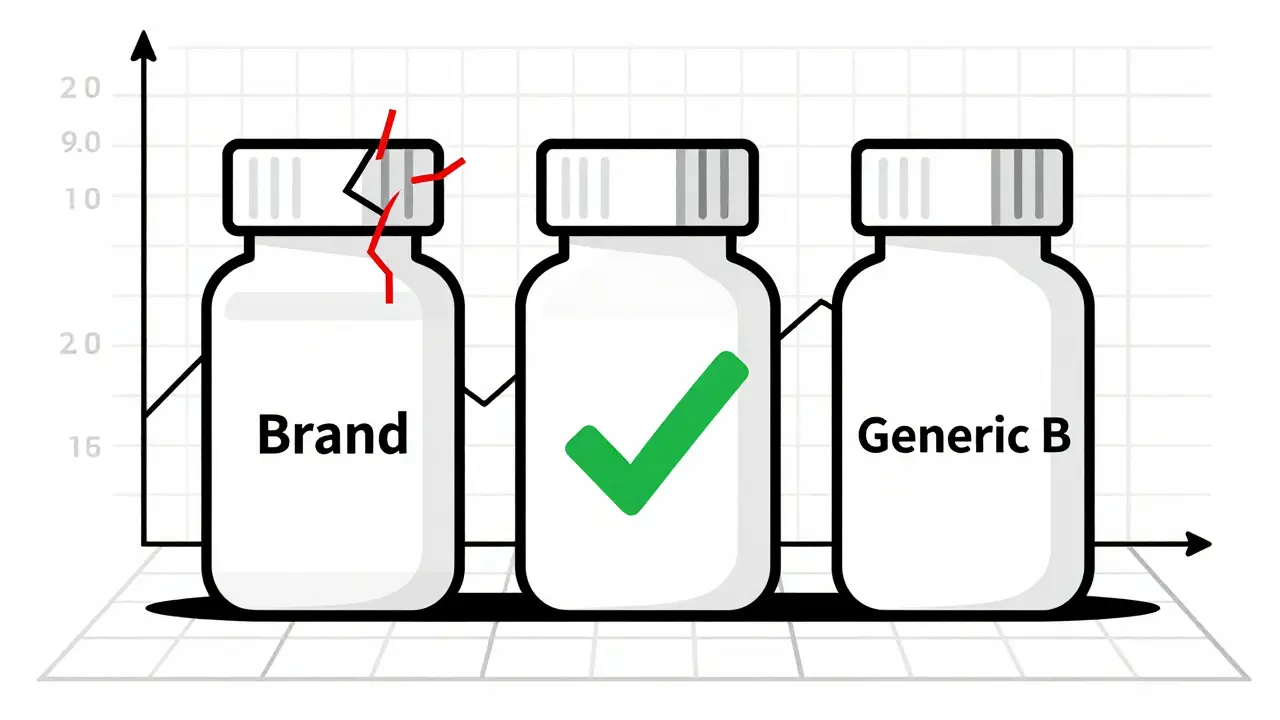
Even if two versions of the same drug are labeled the same, their absorption in your body can differ slightly. That’s because of tiny differences in fillers, coatings, or how the pill breaks down. For most drugs, that’s fine. For NTI drugs? It’s a big deal.
A patient taking warfarin switched from brand-name Coumadin to a generic version. Within a week, their INR (a blood test that measures clotting) jumped from 2.5 to 4.1 - a dangerous level. They needed emergency treatment to stop bleeding. This isn’t rare. In a survey of 1,200 patients on NTI drugs, 31% had to go to the doctor because their levels went too high or too low after a switch.
That’s why the FDA and European Medicines Agency (EMA) require stricter testing for NTI generics. Instead of allowing 80-125% similarity (the normal standard), they demand 90-111%. That’s a much tighter window. Still, not all generics meet that standard - and some pharmacies still substitute without warning.
In North Carolina, pharmacists are legally required to get your doctor’s permission before switching your NTI drug. Other states are catching up. But in many places, you could be switched without knowing - and that’s dangerous.
How to Stay Safe: Monitoring and Consistency
If you’re on an NTI drug, your safety depends on two things: regular blood tests and sticking to the same brand or generic version.
Here’s what you’ll likely need:
- Warfarin: INR tests every 1-4 weeks, especially when starting or changing doses.
- Lithium: Blood level checks every 3-6 months, or more often if your dose changes.
- Levothyroxine: TSH blood test every 6-8 weeks after a dose change, then every 6-12 months if stable.
- Tacrolimus: Blood tests twice a week after transplant, then weekly or monthly as you stabilize.
Don’t skip these. Your doctor isn’t being overcautious - they’re preventing emergencies.
Also, never switch brands or generics without talking to your doctor. Even if the label says the same thing, the pill might act differently in your body. Keep the same pharmacy. Ask your pharmacist to note your NTI drug in your file. If you’re switched, ask: “Is this the same version I was on?”
Recognizing Trouble: Symptoms of Too Much or Too Little
You need to know the warning signs - because blood tests don’t always catch problems fast enough.
For warfarin:
- Too little: New swelling in legs, chest pain, sudden shortness of breath (signs of clots).
- Too much: Unexplained bruising, nosebleeds, blood in urine or stool, severe headaches.
For lithium:
- Too little: Low mood, irritability, return of manic episodes.
- Too much: Hand tremors, slurred speech, confusion, dizziness, muscle weakness - even seizures.
For levothyroxine:
- Too little: Fatigue, weight gain, cold intolerance, depression.
- Too much: Rapid heartbeat, anxiety, weight loss, insomnia, shaking hands.
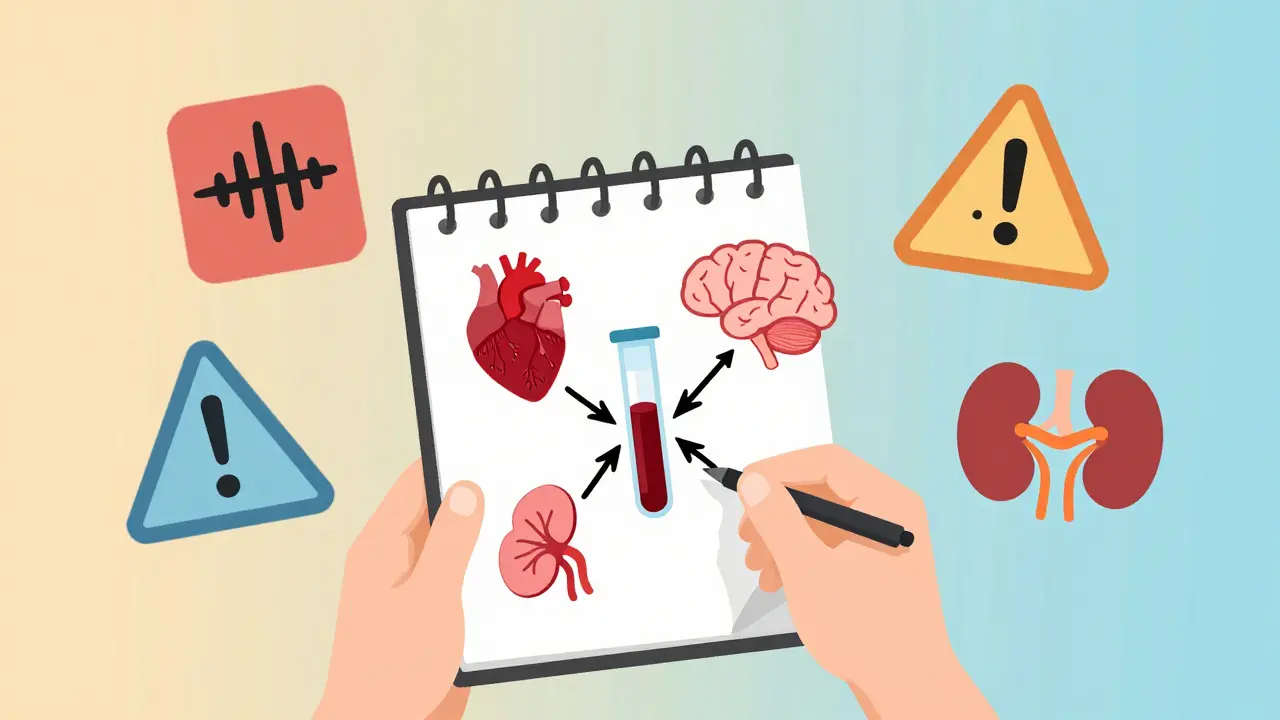
Write these down. Keep a simple log. Note when symptoms start, what dose you’re on, and when your last blood test was. Patients who track their symptoms and doses have 32% fewer bad events.
What’s Changing Now - And What’s Coming
NTI drugs are getting more attention. In 2023, the FDA released new guidance on bioequivalence testing for 15 specific NTI drugs, including levothyroxine and digoxin. They’re also pushing hospitals to use barcode scanning for 12 high-risk NTI drugs to prevent dosing errors.
Big changes are coming on the horizon. Researchers are studying how your genes affect how you process these drugs. For example, two people taking the same dose of warfarin might need completely different amounts because of their CYP2C9 and VKORC1 genes. By 2026, genetic testing before starting NTI drugs could become standard - and could cut adverse events by up to 35%.
There are also new apps approved by the FDA that help you track your meds, symptoms, and lab results. These aren’t magic, but they help you stay in control.
What You Can Do Today
You don’t need to be a scientist to manage an NTI drug. But you do need to be proactive.
- Know your drug. Is it an NTI drug? Ask your doctor or pharmacist - don’t assume.
- Get the tests. Don’t skip blood work. Set phone reminders if you need to.
- Stick to one version. If your pill looks different, ask why. Don’t accept a switch without approval.
- Track symptoms. Keep a notebook or use a simple app. Note changes in energy, mood, heart rate, or bleeding.
- Tell every provider. When you see a new doctor, dentist, or ER staff, say: “I take an NTI drug. My blood levels must be monitored.”
NTI drugs aren’t scary if you understand them. They’re just more demanding. But with the right habits, you can live safely - and well.
Are all generic drugs unsafe for NTI medications?
No, not all generics are unsafe. But they must meet stricter standards to be approved for NTI drugs. The FDA and EMA require generics for NTI drugs to be within 90-111% of the brand-name drug’s effect - much tighter than the usual 80-125%. Some generics meet this standard and are safe. The key is consistency: once you find a generic that works, stay on it. Don’t switch unless your doctor approves.
Can I switch NTI drugs without telling my doctor?
Never. Even a small change in formulation, manufacturer, or even batch can affect how your body absorbs the drug. That can lead to serious harm - like bleeding with warfarin, organ rejection with tacrolimus, or seizures with phenytoin. Always talk to your doctor before any switch. In some states, pharmacists are legally required to get your doctor’s permission before substituting an NTI drug.
How often do I need blood tests for NTI drugs?
It depends on the drug and your situation. For warfarin, you might need tests every 1-4 weeks at first, then every 4-12 weeks if stable. Lithium levels are checked every 3-6 months after stabilization, but more often if you’re sick, change doses, or start new medications. Tacrolimus requires frequent testing - sometimes twice a week - after a transplant. Your doctor will set the schedule based on your needs. Never assume you can skip a test just because you feel fine.
Can food or other medicines affect NTI drugs?
Yes, very much. Warfarin interacts with vitamin K-rich foods (like spinach, kale, broccoli) - sudden changes in your diet can throw off your INR. Lithium levels rise if you’re dehydrated or take NSAIDs like ibuprofen. Levothyroxine shouldn’t be taken with calcium, iron, or coffee - wait at least 30-60 minutes after taking it. Always tell your doctor or pharmacist about every supplement, herb, or over-the-counter medicine you use.
Will I have to take these drugs forever?
It depends on why you’re taking them. For example, people who’ve had organ transplants usually take tacrolimus for life. Those with bipolar disorder often take lithium long-term. But some, like patients on levothyroxine after thyroid removal, will need it permanently too. Others, like those on methotrexate for rheumatoid arthritis, may eventually reduce or stop if their condition improves. Your doctor will monitor your condition and adjust your plan - but never stop or change your dose without talking to them.
Final Thought: You’re the Most Important Part of the System
Doctors, pharmacists, and labs all play a role - but you’re the one taking the pill every day. You’re the one noticing when you feel off. You’re the one who remembers to get your blood drawn. NTI drugs demand attention, but they don’t have to control your life. With knowledge, consistency, and communication, you can manage them safely - and live fully.
venkatesh karumanchi
January 23, 2026 AT 16:04This post hit home. My dad’s on warfarin and we almost lost him last year when the pharmacy switched his generic without telling us. He started bleeding internally from a tiny bruise. Never again. I now print out the FDA guidelines and hand them to every pharmacist. Knowledge is power, but consistency is life.
Thanks for laying this out so clearly.
Jenna Allison
January 25, 2026 AT 15:09As a clinical pharmacist, I can confirm: NTI drugs are the most high-stakes part of my job. I’ve seen patients on levothyroxine go from euthyroid to myxedema coma because they switched generics and didn’t get tested for 6 months. The 90-111% bioequivalence window isn’t just bureaucracy-it’s a lifeline.
Always ask for the brand name if you’re unstable. And if your pharmacy says ‘it’s the same,’ ask for the manufacturer code. Most won’t give it to you unless you insist.
Vatsal Patel
January 26, 2026 AT 07:07Oh wow. So we’ve turned medicine into a game of Russian roulette with pill bottles? Brilliant. Just brilliant.
Let me guess-the next step is requiring patients to sign a waiver before taking a pill that might kill them if the filler in the tablet is 0.3% off. At least we’re honest now. We’re not pretending we know what we’re doing-we’re just pretending we’re trying.
Meanwhile, Big Pharma laughs all the way to the bank while you bleed internally from a generic switch. Humanity’s finest hour.
Sharon Biggins
January 28, 2026 AT 04:02Thank you for this. I’ve been on lithium for 8 years and I didn’t even know it was an NTI drug until I read this. I thought my tremors were just stress. Turns out I was 0.2 mmol/L over the limit.
Now I have a phone calendar alert for my blood draws and I only use the same pharmacy. I even wrote a note on my fridge: ‘Lithium = No Ibuprofen.’
You’re not alone. You’re not crazy. You’re just taking a drug that demands respect. Keep going. You’ve got this 💪
lorraine england
January 28, 2026 AT 12:55My sister got switched from brand-name Coumadin to a generic and her INR spiked to 6. She ended up in the ER with a brain bleed. They didn’t even tell her it was a switch. The pharmacist said ‘it’s the same thing.’
Turns out, it’s not. And now she’s on a legal case against the pharmacy chain. If you’re on an NTI drug, don’t trust the system. Protect yourself. Ask for the brand. Write it down. Be annoying. It’s worth it.
Kat Peterson
January 29, 2026 AT 10:04OMG I CRIED READING THIS 😭😭😭
I’ve been on tacrolimus since my kidney transplant and I swear every time I see my pill bottle I whisper ‘please don’t kill me’
And then my pharmacy switched it last month and I had to go to the hospital AGAIN because my levels dropped. I’m so done with this. I now have a laminated card in my wallet that says ‘I AM ON A NTI DRUG. DO NOT SUBSTITUTE. CALL MY DOCTOR.’
Can someone make a TikTok trend for this? #NTIWarrior #DontSwitchMyPills
Himanshu Singh
January 31, 2026 AT 04:58There’s a quiet tragedy in how we treat these drugs. We give them to people who are already fragile, then treat their bodies like interchangeable parts. We say ‘it’s the same molecule’-but biology isn’t chemistry. It’s poetry. And poetry doesn’t tolerate typos.
Every time a pharmacist swaps a pill without consent, they’re rewriting someone’s story without asking if they’re ready for the next chapter.
Maybe the real NTI drug isn’t the medicine-it’s the system that forgets patients are human.
Elizabeth Cannon
February 1, 2026 AT 04:22So many people don’t realize that levothyroxine isn’t like taking a vitamin. It’s a hormone. And your body doesn’t care if the pill is made in India or Ohio-it cares if the absorption is consistent. I switched brands once and gained 15 pounds in 3 weeks. My doctor said ‘it’s just water weight.’
NO. IT WASN’T. I tracked my symptoms. I demanded a TSH test. Turns out my dose was off by 25 mcg.
Don’t let anyone dismiss you. If you feel off, it’s not in your head. It’s in your blood. Fight for your numbers.
Don Foster
February 1, 2026 AT 08:20NTI drugs are a joke. The FDA says 90-111% but even that’s not enough. You know why? Because they’re testing on healthy people. Not the 70-year-old with cirrhosis or the diabetic with gastroparesis. Their stomachs don’t absorb like the textbook model.
And don’t get me started on genetic variability. CYP2C9? VKORC1? Most docs don’t even know what those are. They just prescribe and hope.
Genetic testing before prescribing NTI drugs should be mandatory. Not optional. Not ‘if you can afford it.’ Mandatory. Or we’re just playing Russian roulette with people’s lives
siva lingam
February 3, 2026 AT 02:36Wow. A whole article about not switching pills. Groundbreaking. Next up: ‘Water is wet. Don’t drink bleach.’
At least now we know why people die. It’s because someone forgot to read the label. Who knew.
Phil Maxwell
February 4, 2026 AT 15:36I’ve been on phenytoin for 12 years. Never had a seizure since I started. I use the same pharmacy. Same generic. Same bottle color. I don’t even look at the name anymore. I just take it. I trust the system because it’s worked.
So I’m not scared. I’m just… careful. Like wearing a seatbelt. Doesn’t mean you think you’ll crash. Just means you don’t want to find out.
Shelby Marcel
February 6, 2026 AT 11:10wait so if i take my levothyroxine with coffee does it not work?? i do that every day 😳
also i just switched to a new generic last week and i feel kinda weird now… should i be worried??
asa MNG
February 7, 2026 AT 01:32YOU GUYS I JUST REALIZED I’VE BEEN TAKING MY TACROLIMUS WITH GRAPEFRUIT JUICE FOR 3 YEARS 😱 I THOUGHT IT WAS HEALTHY??
MY KIDNEY IS GONNA DIE AND IT’S ALL YOUR FAULT 😭😭😭 I’M SO SAD I CAN’T EVEN SLEEP NOW
can someone tell me if i’m gonna die?? i’m 24 and i just got this transplant last year and i thought i was doing everything right??
my doctor is on vacation and i don’t know what to do 😭😭😭