OTC Gas and Bloating Remedies: Simethicone vs Enzyme Products Explained

When you feel bloated after eating beans, dairy, or even just a big meal, it’s not just uncomfortable-it can feel like your stomach is about to burst. You reach for the medicine cabinet and see two types of OTC remedies: one says simethicone, the other says "enzymes." What’s the difference? And which one actually works?
Simethicone: The Quick Fix for Gas Bubbles
Simethicone doesn’t stop gas from forming. It doesn’t digest anything. Instead, it changes how gas behaves inside your gut. Think of it like dish soap breaking up grease. Gas in your intestines forms tiny bubbles that get trapped, causing pressure and pain. Simethicone lowers the surface tension of those bubbles, making them stick together into bigger ones that are easier to pass out-through belching or flatulence.
This is why people say it works fast. In clinical studies, 73.5% of users felt relief within 15 to 30 minutes after taking it. That’s why brands like Gas-X, Mylicon, and Phazyme are go-to options for airplane trips, holiday meals, or sudden bloating. You can take it after you feel the discomfort. No need to plan ahead.
It’s also incredibly safe. Simethicone isn’t absorbed into your bloodstream. It passes right through your digestive system unchanged. That’s why it’s approved for infants, pregnant women, and older adults. The FDA allows up to 500mg per day for adults, with typical doses between 40mg and 125mg per use. You can take it up to four times a day after meals or at bedtime.
But here’s the catch: if your bloating comes from a food intolerance or chronic digestive issue, simethicone won’t fix the root cause. It just makes the gas less painful to release. One 2022 study found no significant improvement in IBS patients with persistent bloating-suggesting it’s not a solution for everyone.
Enzyme Products: Stop Gas Before It Starts
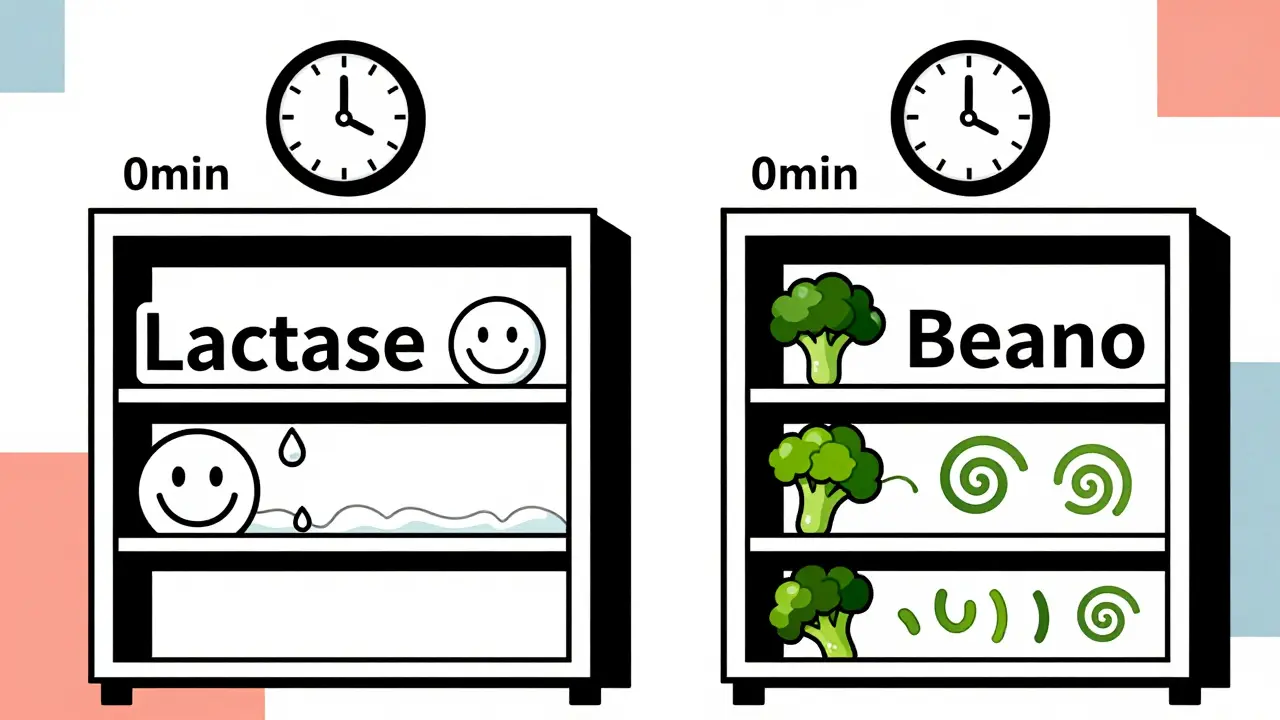
Enzyme products work differently. They don’t touch existing gas. They break down the foods that create gas in the first place. There are two main types you’ll find on shelves: lactase and alpha-galactosidase.
Lactase is the enzyme your body naturally makes to digest lactose-the sugar in milk and dairy. If you’re lactose intolerant, your body doesn’t make enough. That’s where products like Lactaid and Dairy Digest come in. Each tablet or drop contains 3,000 to 9,000 FCC units of lactase. You take it right before eating dairy. If you do it right, studies show it prevents bloating, cramps, and diarrhea in up to 86% of people with lactose intolerance.
Alpha-galactosidase (sold as Beano) targets complex sugars in beans, broccoli, cabbage, and whole grains. These sugars can’t be broken down by your own enzymes, so gut bacteria ferment them-and produce gas as a byproduct. Beano contains 450-1,200 GalU per dose. You need to take it 5 to 10 minutes before eating those foods. It won’t help if you take it after.
But here’s the problem: Beano doesn’t work for everyone. Effectiveness ranges from 45% to 78%, depending on your gut bacteria, the type of food, and how much you ate. Some people swear by it. Others say it’s useless. A 2020 study in the American Journal of Gastroenterology found it only worked reliably for certain types of beans-not all.
Simethicone vs Enzymes: Which One Should You Use?
Here’s the simple breakdown:
- Use simethicone if you’re suddenly bloated and don’t know why-or if you’ve already eaten the trigger food. It’s your emergency button.
- Use enzyme products if you know exactly what’s causing your gas (like dairy or beans) and you can plan ahead.
They’re not competitors. They’re teammates. Many users on Reddit and Amazon say they use both: Beano before chili night, and Gas-X afterward if they’re still feeling full. That’s smart. One prevents. One relieves.
Market data backs this up. Simethicone makes up 58% of the $1.2 billion OTC gas relief market. Enzymes are smaller (32%) but growing faster-thanks to rising awareness of lactose intolerance (affecting 36% of U.S. adults) and more people testing for food sensitivities.
What About Combination Products?
Companies noticed people using both. So now you’ll find combo products like Gas-Zyme or Mylanta Gas Relief Plus Enzyme. These mix simethicone with alpha-galactosidase. They’re gaining traction, with sales up nearly 19% year-over-year. They’re convenient-if you’re unsure whether your bloating is from dairy or beans, this gives you both tools in one pill.
But they cost more. A 100-count bottle of Beano runs about $18.99 at CVS. A 200-count bottle of Gas-X is $12.49. The combo packs? Often $25+. If you only need one type, stick to the single-ingredient option.
How to Use Them Right
Most people mess up the timing. Here’s how to get it right:
- For simethicone: Chew the tablet fully or swallow the capsule whole after meals or when bloating hits. No need to wait. Take up to four times a day.
- For lactase: Take it right before you eat dairy. If you take it 15 minutes after your yogurt, it’s too late.
- For Beano: Take it 5-10 minutes before beans, lentils, or cruciferous veggies. Don’t wait until you’re halfway through your meal.
Also, don’t expect miracles. Enzymes won’t help if you eat a whole bag of beans. Simethicone won’t fix chronic bloating from IBS or SIBO. These are tools, not cures.

What Users Really Say
On Amazon, Gas-X has over 18,000 reviews with a 4.5-star average. Top comments: “Works in minutes,” “Saved my flight,” “I keep it in my purse.”
Beano has 6,800 reviews and a 4.2-star rating. Positive reviews say: “Essential for Thanksgiving,” “I can eat beans again.” Negative ones: “Didn’t do anything,” “Too expensive for daily use.”
On Reddit’s r/GIhealth, a common thread: “I use Beano before I eat beans. If I’m still bloated after, I take Gas-X. That’s my system.”
WebMD user reviews show 82% found simethicone helpful for occasional gas-but only 37% said it helped with chronic bloating. That’s the key distinction.
When to See a Doctor
OTC remedies are great for occasional discomfort. But if you’re bloated every day, have pain, diarrhea, constipation, or weight loss, it’s not just gas. It could be IBS, celiac disease, SIBO, or another condition. The National Institute of Diabetes and Digestive and Kidney Diseases (NIDDK) says simethicone is fine for symptoms-but if you’re relying on it daily for months, it’s time to get checked.
Dr. Michael Camilleri from Mayo Clinic puts it simply: “Simethicone is safe and fast, but it’s not a substitute for figuring out why you’re bloating.”
Final Thoughts: Choose Based on Your Situation
There’s no single best product. It depends on your life, your diet, and your body.
If you eat dairy and get bloated? Lactase is your best friend.
If you love beans and beans make you gassy? Try Beano before your meal.
If you’re bloated after a big meal and don’t know why? Grab simethicone.
And if you’re still unsure? Keep both on hand. Use enzymes to prevent. Use simethicone to relieve. That’s what most smart users do.
The bottom line: OTC gas remedies aren’t magic. But when used correctly, they’re simple, safe, and surprisingly effective-for the right situation.
Kim Hines
December 15, 2025 AT 20:14Been using Gas-X since college. Still don’t know why it works but it does. No questions asked. Just pop one and wait for the pressure to vanish like it never existed.
sue spark
December 16, 2025 AT 07:11i used to think enzymes were for people who overthink their food but then i ate a whole pot of chili and realized maybe i’m the one who needs to stop pretending i’m not lactose intolerant
James Rayner
December 16, 2025 AT 19:49It’s funny how we treat our guts like malfunctioning machinery… we throw chemicals at them like they’re engines and expect silence. But the body isn’t a car-it’s a conversation. Simethicone doesn’t fix the noise, it just muffles it. Enzymes try to change the fuel. But maybe the real question is: why are we eating things that make us this uncomfortable in the first place? 🤔
Kayleigh Campbell
December 18, 2025 AT 13:25Beano is basically the adult version of wearing a seatbelt-you don’t need it until you crash. And then you’re like ‘why didn’t I just not eat the beans?’ But hey, at least now I’ve got a legit excuse to say ‘no thanks’ to potlucks.
Dave Alponvyr
December 19, 2025 AT 23:03Simethicone after. Enzymes before. Done. Stop overthinking it.
Randolph Rickman
December 21, 2025 AT 13:02For anyone still debating this-stop. Use both. It’s not about being right, it’s about being comfortable. I take Beano before my weekly chili night, then Gas-X if I’m still feeling like a balloon after dinner. Works every time. No shame in having a system. Your gut will thank you.
Andrew Sychev
December 22, 2025 AT 21:51Somebody’s gotta say it-these products exist because we’ve collectively decided that beans, dairy, and ‘big meals’ are non-negotiable parts of modern life. We don’t change our habits. We just buy more plastic bottles with tiny pills inside. The real solution? Eat less. But no, we’d rather pay $25 for a combo pack that says ‘magic in a capsule.’
Billy Poling
December 24, 2025 AT 14:44It is of considerable interest to note that the physiological mechanism underlying simethicone’s efficacy is rooted in its ability to alter interfacial tension within gastrointestinal luminal contents, thereby promoting coalescence of dispersed gas microbubbles into larger, more mobile aggregates-thereby facilitating expeditious evacuation via eructation or flatus. In contrast, enzymatic supplementation functions through substrate-specific hydrolysis of indigestible oligosaccharides, thereby reducing the availability of fermentable substrates for colonic microbiota. The clinical implications of this dichotomy are profound, particularly in the context of functional gastrointestinal disorders wherein etiological heterogeneity necessitates a stratified therapeutic approach. Furthermore, the rising market penetration of combination formulations suggests a paradigmatic shift toward multimodal symptom management, albeit at a premium cost that may not be justified in all patient populations.